

 Preview unavailable. Open the source below.
- Works with
- Shopify
- How it connects
- Native integration · API connection
- Availability
- AvailableAvailable as a Shopify app. Credit allowances and connector setup govern individual workflows.
Is it right
for your store?
Fit matters more than a feature count.
Consider StoreSEO when Shopify catalog cleanup is the immediate job. Start with a representative set of products, review the suggested copy and measure changes in Search Console. Match the plan to product count and generation use; a better internal SEO score alone does not establish more traffic or sales.
Research checked · Based on published sourcesA good fit for
- Shopify merchants updating titles, descriptions and image alt text
- Small teams combining catalog SEO work with search and AI visibility monitoring
Look carefully if
- Stores needing a verified native WooCommerce or multi-platform catalog connector
- Expecting unlimited product coverage or AI generation in the entry plan
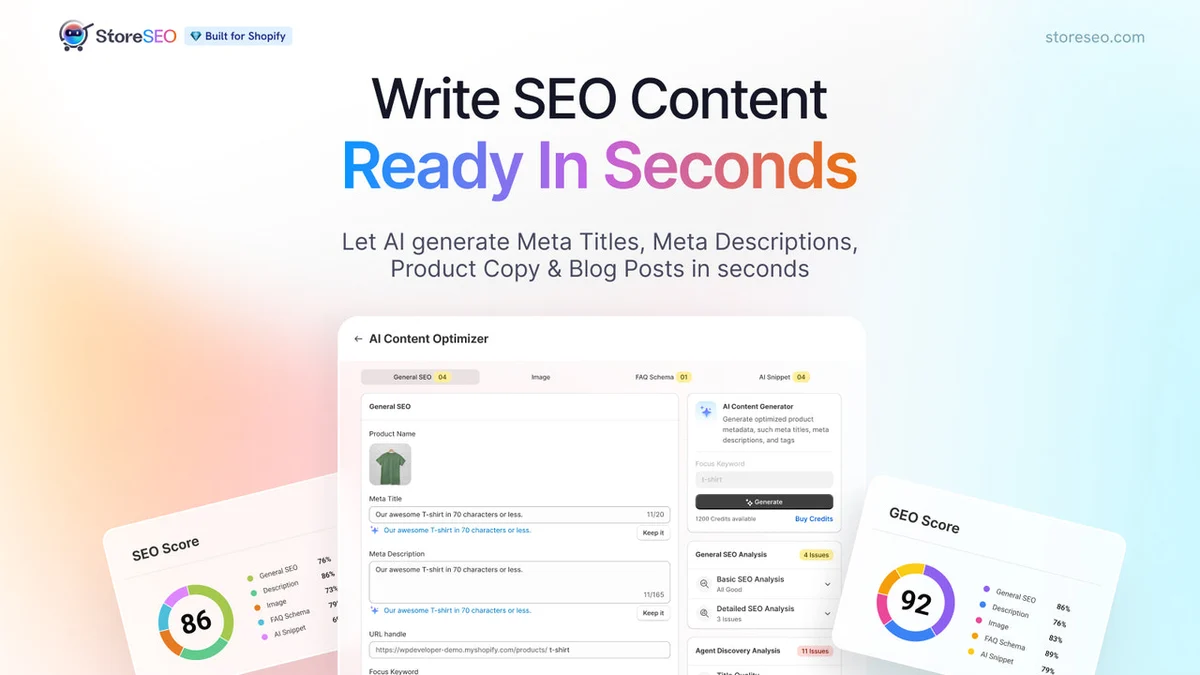
Find SEO issues in Shopify products and pages, generate metadata from a focus keyword, and manage image optimization. StoreSEO also documents keyword tracking, AI-answer analysis and an MCP connection for running store SEO tasks from supported AI assistants.
Documented strengths
- Metadata suggestions can be kept, regenerated or reverted before saving
- Shopify image, schema and metadata tasks share one app
- AI Insights records brand mentions, sentiment and competing brands
What it
can do.
Coverage and conditions, side by side.
Product SEO checks
Analyze product and page SEO, then review the issues and score in the app. Product coverage follows the plan limit.
Source : Product SEO checksMetadata generation
Generate titles, descriptions and tags from a focus keyword, then keep, regenerate or revert the suggestion before saving.
Required plan Available AI credits
Source : Metadata generationKeyword rank tracking
Configure keywords for a selected location and monitor their positions. Free lists five keywords; paid plans increase the allowance.
Required plan Plan keyword allowance
Source : Keyword rank trackingAI brand visibility
Configure a brand and competitors, review generated queries and query supported AI platforms. The interface estimates credit use before analysis.
Required plan AI Insights access and sufficient credits
Source : AI brand visibilityImage optimization
Compress and resize Shopify images within the plan allowance; review image quality before applying changes across a catalog.
Required plan Plan image allowance
Source : Image optimizationMCP and AI Toolkit
Connect a compatible AI assistant through MCP or configure AI Toolkit access with a token to perform supported SEO actions.
Required plan Configured connector or AI Toolkit access
Source : MCP and AI ToolkitWhat the
price buys.
Starting prices are only part of the bill.
Lite lists 100 products, 500 images and 1,000 AI credits. Essential is US$39.99 for 250 products, 2,000 images and 5,000 credits. Free lists 25 products, 25 images, 200 credits and five tracked keywords; paid plans advertise a seven-day trial. Extra AI-credit bundles are sold separately.
- Charged by
- Products + images + AI credits
- Commitment
- Shopify recurring billing every 30 days
- Required plan
- Lite for the listed paid allowance and Google integrations
Checked Oct 4, 2026. Usage, add-ons and taxes may change the total.
Plans and
practical questions.
Worked examples are planning scenarios, not measured product results.
Where it
fits in.
Check the connection your workflow needs.
Shopify
Install the official Shopify app and sync products. Save reviewed changes to store metadata; product and image coverage depend on the subscribed plan.
Google Search Console and Analytics
Lite and higher list Google integrations and sitemap submission. Connect the relevant Google property to use your store’s performance data.
AI assistants
A remote MCP connector and an AI Toolkit are documented for supported clients. Set up the connection and review the actions requested against your Shopify store.
Browser-based tools can support a Shopify workflow without a native Shopify integration. Connection methods reflect the documented workflow.
The details
that matter.
Limits are part of choosing well.
Plans have separate product, image and AI-credit allowances. Budget for both catalog size and repeated generation; additional credit bundles can increase the total.
The current App Store listing and website agree on Lite at US$14.99, but the image-limit help article contains older plan figures. Check the in-app subscription screen before approving billing.
AI visibility analysis consumes credits and shows a usage estimate before running. A visibility score or LLMs.txt file does not guarantee citation by an answer engine.
Generated metadata and alt text still need review for product accuracy and accessibility. ToolClue has researched the documentation but has not tested store changes or ranking results.
This profile is based on published sources. No independent test record is published for this profile. “Not confirmed” means the available evidence has not established the claim.
- Shopify app, current USD pricing and plan limitsapps.shopify.com
- Plan comparison and additional credit bundlesstoreseo.com
- Generate, review, revert and save metadatastoreseo.com
- Keyword rank-tracker setupstoreseo.com
- AI Insights setup and credit estimatestoreseo.com
- Image compression and resizing workflowstoreseo.com
- Image-allowance behavior; older plan figuresstoreseo.com
- Additional AI-credit bundlesstoreseo.com
- MCP connector and AI Toolkitstoreseo.com
Material changes can happen between reviews. Confirm current capabilities, plans and terms with the vendor.
Other tools to consider.

Managed SEO with search and AI visibility reporting
US$99/month for managed SEO
AI assistance already inside an eligible Shopify plan
Included with eligible Shopify plans